Saturday, January 12, 2013

Links

Important Tools 

Skydrive.live.com - Microsoft Office Apps
CSULB - Webmail
Keepvid.com - YouTube
FVD Video Downloader (For Chrome)
California Documents - First American Title
California Documents - LA County Recorder
LA County - Tax Assessor Parcel Information
Places Please
Sigalert
Daily Kos
Google News
Yahoo News
PBS Political Wrap
Inside Washington
TV Newser
MSNBC (Click On Video)
Real Clear Politics
Talking Points Memo
Mother Jones
Huffington Post - Pollster
Five Thirty Eight (Nate Silver)
USA Today
Filmon.com - CBS Evening News
Buzz Feed

Bookmarks - Important Information 
California VLF Calculator - DMV - Income Taxes
Koch Brother Products To Avoid
Recreate DVD From VOBs
CSULB - Webmail
Experian Tenant Screening
How To Thread A Singer Sewing Machine
How To Remove Windows Log-on Screen

Bookmarks - Shopping

Being Human
Call The Midwife
DCI Banks
Death In Paradise
Endeavour
Father Brown
George Gently
Great Houses With Julian Fellowes
The Hour
Lewis
Marple: Julia McKenzie
Midsomer Murders
Midsomer Murders (2)
Miranda
Murdoch Mysteries
New Tricks
Poirot
Ripper Street
Sherlock
Silent Witness
Vera
Wallander
Whitechapel

Bookmarks - Downloads

Keepvid.com - YouTube
The Paradox
Gelo - Mismusicales.Blogspot.com/


Sunday, July 1, 2012

Free Software

The following is a list of software that I have useful at different times.  I just bought a new computer, and having this listing made it easy for me to find and install the programs on it.

 General Programs

  • Nitro Reader Three. This program is a free PDF Reader and Writer. When you download it from the publisher, there does not seem to be any spam, adware or other programs installed.

Video and Audio Programs


Freemake Video Converter 

  • I used to love this program. Not only does it easily convert videos from one format to another, but it will take a video files (or multiple files) and create DVD folders that I can use to burn DVDs (using Imgburn).  It also joins files together, and it extracts mp3 files from video files.

    The reason why I have become disappointed with this program is that when it makes a DVD sometimes the video freezes (but the audio plays fine).  I then have to play with converting the program to a new format to fix the problem.

Handbrake

  • I love this program. It rips a mp4 video from a commercial DVD. Change the extension to mp4 after it is done.  There is no watermark.

Spesoft Free Text To MP3 Speaker 

  • I love this program. It creates an mp3 file out of text.

Atube-catcher

  • I love this program. I can't get it to download the streaming video, but it has a great Screen Recorder.  I have been able to record a video playing on the PBS website.  It can create DVD iso images and burn DVDs.  

Imgburn

  • I love this program. This program allows you to burn a DVD from a DVD foler (VIDEO_TS) or from an ISO file.  If you need an ISO file, it can create one from a DVD.
7-Zip

  • I love this program. I am often given video files that have been separated into parts and compressed.  This program will join and decompress the files.  All I have to do is click on the first file and 7-zip does the rest.  

DVD Fab Decrypter
  • This program supposedly lets you ripper the Video_TS folder from a commercial DVD. I used it to rip a UK commercial DVD, but it leaves a large watermark.

Winrar
  • I sometimes get a set of 7z files, which are separated and compressed.  I haven't been able to get 7-zip to handles these files yet. (I am sure that 7-Zip does handle these files, but I am doing something wrong.) Winrar joins and decompresses these files for me.  I just click on the zip file, and Winrar does the rest.

Windows Live Movie Maker
  • I love this program. This program allows you to edit videos and make WMV files.  I like that it lets you substitute an audio file for the audio track already in the video.  It also lets you blend the two audio files.  
Audacity
  • I love this program. This program allows you to modify audio files and to convert them from one format to another. 
Vobedit
  • This program allows you to create a DVD from VOB files.  It works with Ifoedit.  Among my links (at the top of the Blog), you can find a tutorial on how to do this. 
Ifoedit
  • This program allows you to create a DVD from VOB files.  It works with Vobedit.  Among my links (at the top of the Blog), you can find a tutorial on how to do this. 
Dvdstyler
  • This program lets you create DVDs from video files.  It allows you to add hard subtitles to your video if you have a subtitle file. This is what I use it for.  Otherwise, I find Freemake Video Converter easier to use.
Hjsplit.exe
  • You can use this program to separate video files into smaller files, and then join them back into the original file.  It comes it handy in uploading larger video files to filelockers. 
Dvdflick
  • This program lets you create DVDs from video files.
Format Factory
  • This program converts videos from one format to another. 
Yaai.exe
  • This program supposedly allows you to try to correct audio sync problems in your video files. I haven't had a lot of success with this file, but I still thought that I would list it.
Avidemux
  • This is a highly regarded program that allows you to edit videos.  It is too complicated for me.
Freestudio
  • This suite of freeware programs has a lot of programs that can be useful in editing and burning DVDs and CDs.  
Freevideotomp3converter
  • This program will extract the audio from a video file and create an mp3 file.  It can be useful if Freemake is causing you problems.  
Freevideotomp3converter
  • This program will extract the audio from a video file and create an mp3 file.  It can be useful if Freemake is causing you problems.
  • This program unzips files.  Get the non-commercial free version.
  • This program looks a lot like ImgBurn.  I noticed that it allows you to create an audio CD from audio files.
  • I haven't used this yet, but it says that the audio burning software never expires.
  • I to download videos from YouTube with KeepVid, but for non-YouTube videos, I have had a lot of luck with this Firefox add-on. Of course, you will have to install Firefox first.

Free Media Players:


  • This program is a free video player.
Vlcmediaplayer

  • This program is a free video player.
Kmplayer

  • This program is a free video player.
Free Anti-Virus and Malware Programs:


Avast

  • This is a free anti-virus and malware program.

CCleaner

  • This is a free registry cleaning and malware program.

Spybot Search and Destroy

  • This is a free malware program.
AVG

  • This is a free anti-virus and malware program.
Malwarebytes
  • This is a free malware program.
Windows Security Essentials
  • This is a free anti-virus and malware program.
Adaware
  • This is a free malware program.
Free Anti-Virus and Malware Programs:


Eudora OSE
  • This is a free email program.  It is a refinement on Mozilla Thunderbird.  I enjoy it.
Mozilla Thunderbird
  • This is a free email program.
AOL Press
  • This program only works with 32-bit Windows. AOL Press is a wonderful WYSIWYG HTML Editor.
Artweaver Free
  • This program a free art program. If you need to do art that is beyond the Windows Paint program, this usually does it. 


Thursday, October 13, 2011

Black Death


Using DNA taken from centuries-old skeletons, scientists have cracked the genetic code of the bacterium that caused the Black Death, one of history's worst plagues. They found that the germ, Yersinia pestis, is almost identical to germs that are around today.

There are only a few dozen changes among the more than 4 million building blocks of DNA, according to a study published online Wednesday in the journal Nature.

That suggests that the Black Death, or plague, was so lethal for reasons beyond its DNA, study authors said. It had to do with the circumstances of the world back then.

In its day, the disease killed 30 million to 50 million people - about 1 in 3 Europeans. It struck at a time when the climate was suddenly cooling, in the midst of war and famine, and people were moving into closer quarters where the disease could spread easily, scientists say. And it was likely the first time this particular disease had hit humans, suggesting that their immune defenses against the germ were lacking.

"It was literally like the four horseman of the apocalypse that rained on Europe," said study author Johannes Krause of Germany's University of Tubingen. "People literally thought it was the end of the world."

In devastating the population, Yersinia changed the human immune system, wiping out people who couldn't deal with the disease and leaving the stronger to survive, said study co-author Hendrik Poinar of McMaster University in Ontario.

Today, simple antibiotics like tetracycline can beat the plague bacterium, which seems to lack the properties that enable other germs to become drug resistant, Poinar said. Plus, advances in medical treatment, coupled with improved sanitation, put humanity in a better position. And there's an immune system protection we mostly have now, Poinar said.

"I think we're in a good state," Poinar said. "The reason we do so well is that conditions are so different."

People still get the disease, usually from fleas from rodents or other animals, but not often. Worldwide, there are around 2,000 cases a year, mostly in rural areas, with a handful popping up in remote parts of the U.S., according to the CDC. Earlier this year, two people in New Mexico were diagnosed with plague. In 1992, a Colorado veterinarian died from a more recent strain, one that scientists used heavily in their study.

Thursday, October 6, 2011

Akrotiri

Many years ago, at the beginning of his career, a Greek archaeologist named Spyridon Marinatos was digging out a ruined Minoan villa at Amnissos, the ancient port of Knossos on Crete. The villa was once a beautiful mansion with a superb view of the sea, but there is wasn’t much to see when I visited. It is now mostly rubble, a foundation and a few crumbling walls.


The young Marinatos initially assumed an earthquake had wrecked the building. Every archeologist knew tremors plagued the Minoan empire. But when he unearthed a layer of pumice – which comes only from volcanoes – it occurred to him that volcanic activity was somehow involved. This was puzzling, because there is no Cretan volcano that might have deposited the pumice. After further studies, Marinatos published his theory that a volcanic eruption on the island of Thera, more than a hundred miles to the north, had destroyed the Amnissos villa, laid waste to the entire north coast of Crete and ruined the Minoan economy
.
At that time, in the 1930′s, leading archaeologists scoffed at his idea. Marinatos decided the best way to convince them was to excavate on Thera. If he could find Theran pottery of the same period as that of the destroyed palaces and villas in Crete, this would help to prove his theory.


Evidence of ancient habitation – potsherds, worked stone, and the like – had been unearthed near Akrotiri, a farming village at the southern end of Thera. However, no one bothered to investigate further. The village was ignored and local farmers and craftsmen went quietly about their work, as they had done for generations.

All that changed in 1967, when Marinatos – after decades of waiting – finally started digging for Minoan pottery. What he found was far greater than anything he had imagined. While pursuing small clues, Marinatos unearthed a Bronze Age city, well-preserved under six meters of volcanic ash. Akrotiri, whose name was given to the archeological site, suddenly became famous.


Entering the ancient city along the central boulevard, one can see the city as it was 3600 years ago. There are paved streets with a drainage system running under them, and flat-roofed stone buildings with wood framing that was engineered to withstand earthquakes. At the street level are workshops and stores, some of them with large ceramic storage jars (excavators found dried up food products in these). Above the shops are apartments where families lived comfortably with stylish furnishings in decorated rooms. Some homes even have indoor plumbing. Surprisingly, ancient Akrotiri looks very much like modern-day towns on Thera and other Aegean islands.


Walking these streets, one can begin to see how the inhabitants lived, and what sort of dealings they might have had with the Minoan empire on Crete – and with other countries as well. The most obvious clue is in the city itself. Wood was needed to erect houses, make furniture and tools, and (most importantly) build merchant ships that made the island rich. But prior to the great eruption, when the island was much larger than now, there were few trees. So where did Therans get enough wood to build cities and ships? They had to trade with others – Greece, Crete, Anatolia (Turkey), Cyprus, and Syria.

More clues are found in people’s homes. For example, some Akrotiri pottery is similar to Minoan wares, and it dates to the same period as the Cretan disaster (which supports the Marinatos volcano theory).


Other pottery styles indicate extensive trade. The colorful decoration technique used in many Theran vases did not develop locally. It is was copied from pottery of the East. There are even drinking vessels made from ostrich eggs, which suggests trade with Syria, Palestine and Egypt, where ostriches roamed wild.


This trade with eastern cultures also influenced Theran artwork. While the wall paintings in affluent Akrotiri homes maintain their own stylistic characteristics, strong Minoan and Egyptian influences are evident. The stylized wall paintings of ladies and papyrus plants from one house were like the Knossos frescos we saw on Crete. But curious differences suggest questions.


Does papyrus grow on Thera? No. It grows along the Nile River in Egypt. Why are people shown mostly in profile with a rigid stance, one leg placed firmly in front of the other? Many human images in Akrotiri are drawn according to the Egyptian Canon of Proportions, which was a religious art standard. This means each artist followed the same rules in depicting people, using a grid to ensure precision. The same proportions can be seen in the “fisherman fresco” found in another Akrotiri house.


This wall painting depicts a naked young fisherman carrying the day’s catch. Nudity is rare in Minoan art. Another unique feature is the fellow’s head, which appears to be shaved except for a few locks of hair, and painted blue. Some think it was a juvenile fashion, since only young people are shown with shaved heads. Others believe the style is religious and the fresco depicts an offering to the gods. Supporting a religious inference is the fact that the fisherman is walking towards a corner in the room where a table of offerings was found.


Pictures of animals, on the other hand, did not follow the same regulations, so artists had more freedom of expression. The famous “blue monkey” fresco is a good example. This seems to be an amusing composition of monkeys climbing a rocky hillside. These monkeys exude vitality and movement with their elongated, stylized bodies and wildly curvaceous tails. However, the painting also has religious significance, because monkeys were considered servants of the gods. It is believed the monkey motif originated in Crete or perhaps even Egypt, and later became popular on Thera. Artists in all these locations used blue coloring for the monkeys’ fur and skin.


The fresco of the antelopes diverges even more from Egyptian style. The antelopes are depicted using only black lines to define graceful legs, curved backs, long necks, and sharp horns. As a purely decorative painting, its beauty and simplicity is striking – and quite modern. Above the antelopes, a curving red-brown border reflects the curving backs and tails of the animals, creating a pleasant rhythm to the painting. Above that an ivy leaf frieze indicates springtime.


This painting reveals attention to form not seen in Egyptian art. Interestingly, although the antelope (Oryx beissa) is native to East Africa and is a popular subject in Egyptian art, the way it is depicted here reveals a uniquely Theran exuberance and love of beauty. While having integrated subject matter from a trading partner, this artist created a work entirely Theran in character – lively, fluid, and festive.

Minoan and Theran art seems to center on nature and the joys of living, but this focus is more enthusiastic at Akrotiri, where murals explode with color and movement. The clues found in this excavation make it clear that the people of Akrotiri were exposed to ideas and styles from many foreign lands. However, they managed to create their own unique identity.

Tuesday, October 4, 2011

Snow in Los Angeles (January 1932)

The greatest snowfall recorded in downtown Los Angeles was 2 inches (5 cm) in 1932.


It also snowed on the following:

1922 January (trace), March (trace)
1935 December (trace)
1947 December (trace)
1949 January (slightly more than 0.3 inches)
1950 April (0.2 inches)
1951 February (trace), March (trace)
1952 January (trace), March (trace), December (trace)
1954 January (0.3 inches), February (trace)
1957 January (trace)
1962 January (trace)

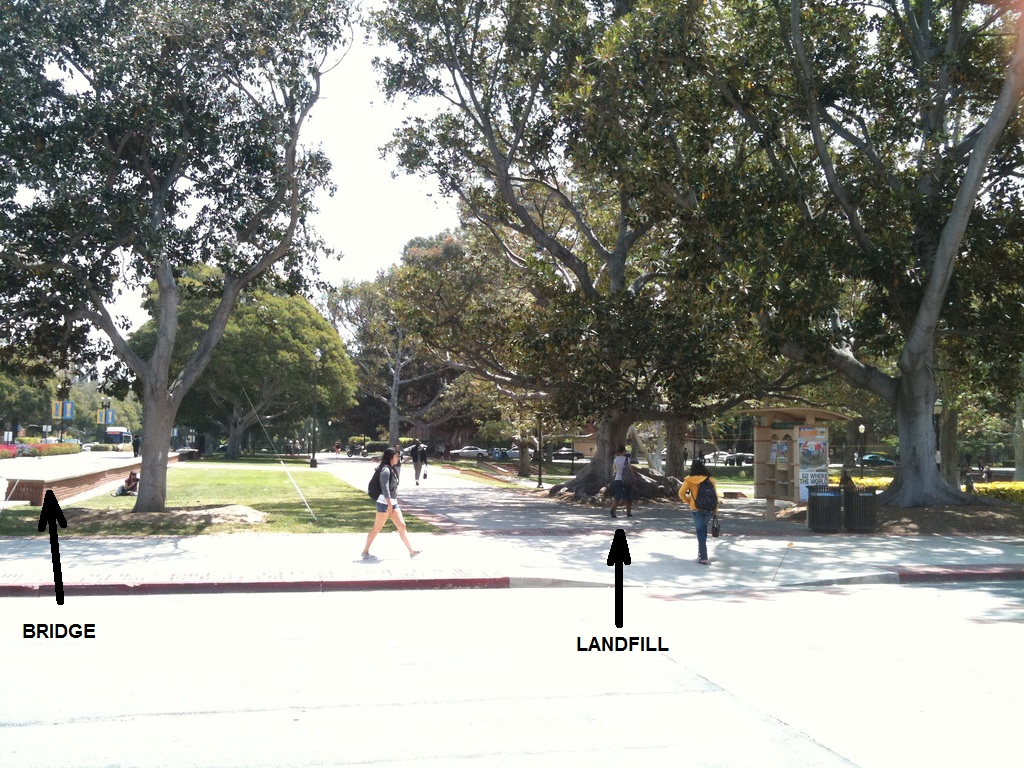
UCLA Bridge

In May 1927, ground was broken at UCLA’s new Westwood campus and the first priority was to construct a bridge to cross the deep arroyo. Modeled in the Roman aqueduct style by University of California supervising architect George W. Kelham, the bridge was necessary for transporting construction supplies over the ravine that divided the east and west parts of the site.


In the summer of 1947, although the bridge was left in tact, the gully to its sides was filled. Today, the bridge’s arches remain hidden underground at Dickson Plaza.


The top sign is the only reference to the UCLA Bridge that remains. Most students do not realize that there is a bridge buried below the road.

Saturday, October 1, 2011

Antinous

Antinous was born to a Greek family in the Roman province of Bithynia in what is now north-west Turkey, and joined the entourage of the emperor Hadrian at a young age, although nothing certain is known of how, when, or where he and Hadrian met. He is constantly described and depicted as a beautiful boy and youth. The relationship is believed to have been sexual. The following busts are of Antinous and Hadrian:
Antinous drowned in The Nile in October 130. Whether this was an accident, murder or suicide remains an unresolved question. The death was presented as an accident, "but it was believed at the time that Antinous had been sacrificed or had sacrificed himself," and Hadrian "wept for him like a woman." Hadrian went through the process of deifying him soon afterwards, a process previously exclusively reserved for imperial family members rather than friends or lovers of non-Roman origin.